
If you buy, sell, or build with plywood, MDF, or particle board, one question decides everything: which standard does your panel meet? Here are the global rules in plain words — and why August 6, 2026 is the date every importer should circle.
One Product, Many Rulebooks
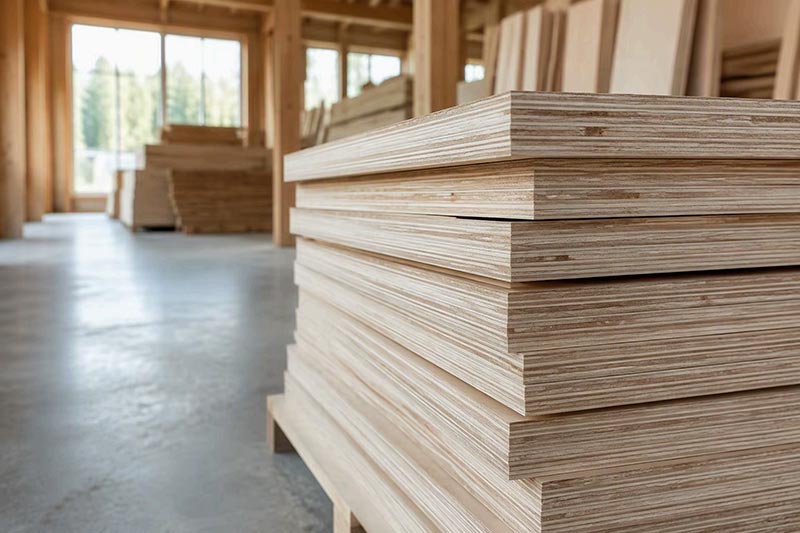
Wood-based panels — plywood, MDF, particle board, OSB — are the backbone of modern construction and furniture. Analysts put the global plywood market at roughly USD 80–96 billion in 2025, with most forecasts showing 4–5% compound annual growth into the early 2030s (Grand View Research; Precedence Research; Fortune Business Insights). Yet the same sheet can be legal in one country and rejected in another — every major market runs its own rulebook, built around two themes: emissions (formaldehyde safety) and performance (structure and durability).
EU: The Toughest New Rule Takes Effect August 6, 2026
The biggest news this week: under the EU’s REACH regulation, a new restriction (Annex XVII, entry 77) takes effect on 6 August 2026. From that date, wood-based panels and furniture sold in the EU must release no more than 0.062 mg/m³ of formaldehyde — exactly half of the familiar E1 ceiling of 0.124 mg/m³ (TÜV SÜD; measurlabs; FORMACARE). The level once considered “good enough for indoor use” is no longer enough: importers need chamber-test evidence under EN 16516, and manufacturers are shifting to low-emission or no-added-formaldehyde resins.
America: CARB P2, TSCA Title VI, and a New ISO Method
The United States runs two linked systems: California’s CARB ATCM Phase 2 and the national EPA TSCA Title VI rule (40 CFR Part 770). Caps differ by product — 0.05 ppm for hardwood plywood, 0.09 ppm for particle board, 0.11 ppm for MDF — and every panel needs third-party certification (EPA; SGS). The new twist: on 6 February 2026 the EPA proposed adopting ISO 12460-2:2024, an internationally recognized small-scale chamber method, as an additional testing route — following CARB’s approval of the same method in September 2024. Expect more test reports issued on one common method.

The Alphabet Soup, Decoded
The most-searched question in the trade — “what do E0, E1, ENF, CARB P2 and F★★★★ mean?” — has a short answer:
E1
- E1— indoor baseline in Europe and China: ≤ 0.124 mg/m³.
E0
- — stricter Chinese grade underGB/T 39600-2021: ≤ 0.050 mg/m³.
ENF
- — China’s strictest grade: ≤ 0.025 mg/m³.
CARB P2
- — California’s Phase 2 limits, required for the US market.
NAF / ULEF
- — “no added formaldehyde” / ultra-low-emitting resins, the closest thing to truly formaldehyde-free panels.
F★★★★
- — Japan’s JIS/JAS top class (desiccator test, 0.3 mg/L).
(Cross-checked against GB/T 39600-2021, EPA/CARB rules, and industry explainers from Yalong Wood and Kapok Panel.)
Structural Standards: CE Marking and Plywood Grades
Emissions are only half the story. In Europe, construction panels carry CE marking under EN 13986, backed by a Declaration of Performance covering strength, moisture behavior, and reaction to fire (GreenSpec; BMTrada). Classic plywood grades A–D describe veneer quality, and exposure ratings tell you whether the adhesive is waterproof — for boat building, marine plywood follows its own spec (BS 1088).
A Simple Buyer’s Checklist
Ask for the emissions class in writing
1. — E1 is the indoor minimum in the EU and China; prefer E0, ENF, F★★★★, or NAF for children’s furniture and tight spaces.
Demand third-party test reports
2. — ISO 12460-2, EN 16516, or CARB/EPA certification. A stamp without a report is just paint.
Match the panel to the job
3. — plywood for strength, MDF for smooth paint, particle board for budget shelving, exterior or marine plywood near moisture.
Watch the calendar
4. — the EU’s 0.062 mg/m³ limit starts this week; panels in transit need compliant documentation now.

The Bottom Line
Standards are converging: lower emissions and verifiable performance. The EU’s new REACH limit, the EPA’s proposed ISO 12460-2:2024 adoption, and China’s E0/ENF grades all point the same way. The winning habit for buyers: never judge a panel by its face — judge it by its paperwork.
Sources
- Grand View Research —Plywood Market Report, 2033(grandviewresearch.com)
- Precedence Research —Plywood Market(precedenceresearch.com)
- Fortune Business Insights —Plywood Market(fortunebusinessinsights.com)
- TÜV SÜD —EU REACH Annex XVII formaldehyde restriction(tuvsud.com)
- measurlabs —Formaldehyde Testing in the EU(measurlabs.com)
- FORMACARE —EU formaldehyde restriction, 6 August 2026 deadline(formacare.eu)
- US EPA —Formaldehyde Emission Standards for Composite Wood Products(epa.gov)
- CARB —Approval Letter for ISO 12460-2:2024(arb.ca.gov)
- SGS —EPA Consults Over Updated Composite Wood Standards(sgs.com)
- ISO —ISO 12460-2:2024 Small-scale Chamber Method(iso.org)
- GreenSpec —Wood Panels: European Standards & CE Marking(greenspec.co.uk)
- BMTrada —CE Marking for Wood-based Panels(bmtrada.com)
- Yalong Wood / Kapok Panel —E0/E1/ENF/F★★★★ explainers(yalongwood.com; kapokpanel.com)
- GB/T 39600-2021 —China formaldehyde emission grading standard(implemented 1 Oct 2021)
Note: market-size figures vary by analyst and are shown as ranges; all standards figures above were cross-checked against at least two independent sources.