
Aug 5, 2026 — Many panel exporters focus only on thickness, size and formaldehyde emissions, yet mechanical strength standards often decide whether a container can enter high-value construction markets. Decorative furniture boards and structural load-bearing panels are not interchangeable. Wrong grading leads to rejected orders, failed site inspections, customs delays or liability risks. This article explains wood panel strength standards in plain language, covering core indicators, widely used global systems, common misunderstandings and practical advice for manufacturers, importers and building contractors.Strength standards define how much load a panel can carry before bending, deforming, splitting or delaminating. They are not abstract laboratory figures. Builders use these values to design floors, walls, roof bracing, formwork and container flooring. Furniture factories rely on strength grades for cabinet frames, tabletops and shelf boards. For exporters, matching the correct strength grade to the target market’s standard directly opens or closes profitable construction and infrastructure channels.

1. Core mechanical indicators buyers and inspectors actually check
Four metrics appear repeatedly in global quotations and test reports.
Modulus of Elasticity (MOE) describes stiffness: how much a panel bends under load. A higher MOE means less deflection. This is critical for long spans such as flooring, shelving and formwork. Buyers searching plywood MOE usually need structural or formwork grade instead of general furniture plywood.
Modulus of Rupture (MOR) is the ultimate bending strength: the maximum load before breaking. MOR matters for safety-critical applications, including temporary construction formwork and load-bearing wall panels.
Internal Bond Strength (IB) measures how firmly the layers or wood fibres stick together. Low IB causes delamination when panels get damp or screwed heavily. Particleboard and MDF are frequently rejected on-site due to insufficient internal bond.
Screw Holding Capacity tells users how well the panel resists screws pulling out. Cabinets, modular buildings and transport packaging all require reliable screw retention. Thin low-density fibreboard often fails this test.
These four values are measured under standard climate conditions. Humidity changes results significantly. Panels stored outdoors without protection will lose strength, even if lab certificates show good performance at factory exit.
2. Major global strength grading systems exporters need to know
Different regions use separate grading frameworks, and one certificate rarely covers all markets.
AS/NZS 2269 (Australia & New Zealand) is one of the most frequently searched standards for structural plywood. It uses F-grade classification such as F8, F11, F14, F17. The F number relates to characteristic bending stress. Higher F grades carry higher allowable design loads. Many exporters confuse F-grade with formaldehyde emission grades; they are unrelated. F-grade only describes mechanical performance. A low-F plywood cannot substitute for F17 formwork panel, even if it meets E05 emission limits.
EN 312 (particleboard) and EN 300 (OSB) are EU baseline strength systems. Particleboard is split into P1 to P7 grades. P1 is general furniture; P4/P5 are humid-condition flooring; P6/P7 are heavy-duty load-bearing boards. OSB is graded OSB/1 through OSB/4 by application: general use, dry load-bearing, humid load-bearing, structural for harsh conditions. Selling OSB/2 as OSB/3 creates compliance risk in EU construction projects.
PS 1-22 (USA structural plywood) and APA performance ratings are widely used in North America. Traders searching structural plywood for US projects often need exposure classification (Exposure 1, Exposure 2) plus span ratings. The span rating tells builders safe floor and roof spacing without extra engineering.
ISO standards provide common test methods rather than a single global grade label. ISO 16978 covers bending tests; ISO 12465 covers internal bond; ISO 12466 covers screw withdrawal. These methods are referenced by most regional standards, which is why labs can often run one test set to feed multiple market certificates.A common trap: customers ask for “structural plywood” without naming the standard. A panel that meets F17 under AS/NZS 2269 may not automatically satisfy EN or US span requirements. The project design standard controls acceptance, not just a generic “structural” description.

3. Common export mistakes related to strength grading
The first mistake is treating thickness as strength. Many buyers assume thicker equals stronger. Density, veneer layout, glue quality and manufacturing pressure matter more. A 12 mm high-density panel can outperform a 15 mm low-density sheet in stiffness and screw pull resistance.
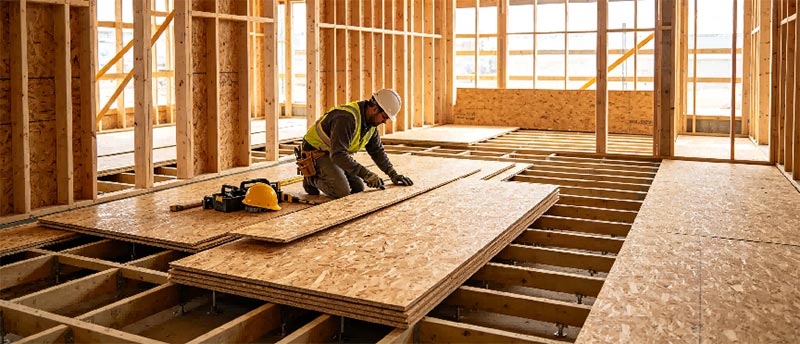
The second mistake is mixing furniture grade with structural grade. Furniture MDF or decorative plywood has no design load rating. When contractors use it for formwork or floor substrate, deflection and failure risks rise sharply. Insurance and warranty coverage may be voided.
Third, factories produce to minimum lab values but ignore consistency. One batch may pass; the next may drift below grade because of log source changes, glue adjustments or shorter pressing cycles. Importers searching reliable structural suppliers consistently complain about variable IB and MOR across shipments.
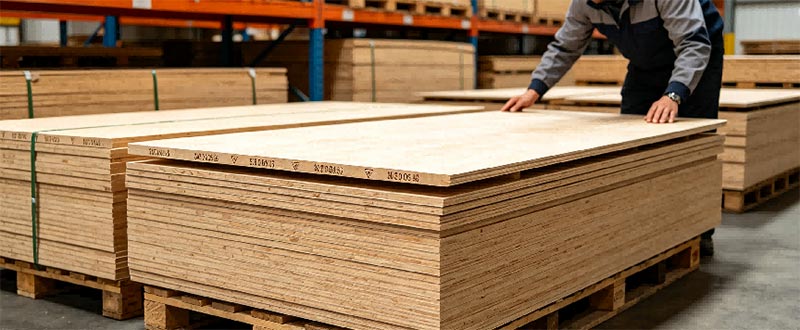
Fourth, documentation mismatch: certificate lists F17, but the stamp on the panel reads general-purpose. Inspectors on-site will reject the goods even if the lab report is genuine. Marking must match certification.Fifth, overlooking service conditions. Strength values are tested at controlled moisture. Panels exposed to rain, ground contact or repeated wetting lose stiffness and bond strength. A grade good for indoor dry use may fail quickly on external formwork.
4. How to use strength grades to capture higher margins
Buyers willing to pay premiums usually need defined mechanical grades, not just cheap sheet goods. Three actions improve negotiation power.
First, clearly separate production lines or batches by grade. Do not run F17 structural plywood and decorative plywood on the same line without strict sorting. Contamination creates liability.
Second, label every sheet consistently: standard name, grade, exposure class, manufacturer traceability. Many importers will pay extra just to avoid re-inspection costs.
Third, quote by standard and grade, not only size. Instead of “1220×2440 plywood”, write “1220×2440 structural plywood AS/NZS 2269 F17, Exposure Bond”. This filters low-price-only buyers and attracts construction distributors.
When a customer asks for formwork panel, confirm the target market standard, design span and expected moisture environment. That one question prevents expensive reclamations and builds trust faster than any sample photo.
5. Industry outlook: tighter enforcement of mechanical compliance
In 2026–2027, building codes and third-party inspectors are raising scrutiny on structural panel performance. EU CPR, Australian building codes and North American green building programmes increasingly require traceable grade marking and valid mechanical test records. Low-price panels without clear strength certification are losing access to institutional projects.The market is splitting: commodity decorative boards compete on price, while certified structural grades maintain stable margins. Factories that control consistent MOE, MOR and IB and document grades properly will capture the growing construction and renovation demand in Europe, Australia and North America.
References & verification sources
- Standards Australia. AS/NZS 2269:2022, Plywood — Structural.
- European Committee for Standardization. EN 312:2022, Particleboards — Specifications; EN 300:2019, Oriented strand boards.
- APA – The Engineered Wood Association. PS 1-22: Structural Plywood Standard.
- ISO 16978, ISO 12465, ISO 12466: Wood-based panels mechanical test methods.
- Timber Research and Development Association (TRADA). Structural wood panel performance guidance for importers.
- IndexBox Global Wood Panel Report Q2 2026: Structural grade import demand by region.
- International Code Council (ICC). Construction substrate panel compliance checklist for commercial projects.